

Why You Should Never Pour Water on a Grease Fire
Safety Education · Home Series
Never pour water on a grease fire. When water touches extremely hot oil, it can vaporize almost instantly and force burning oil outward. The flames may flare up or spread to people and nearby objects. If you cannot control the fire while keeping a safe escape route, leave immediately and call 114.

The instinct to use water often comes from putting out burning materials such as paper or wood. A cooking-oil fire is different. Water and oil do not mix, and the oil may be far hotter than the temperature at which water boils. As a result, an action that seems natural can make the fire much more dangerous and difficult to control.
This article explains the basic principle in plain language and outlines priorities for a home kitchen. It is general safety education and does not replace local fire-service instructions, an emergency plan or hands-on training in the use of fire-extinguishing equipment.
Why can water make a grease fire flare up?
- Water enters the hot oil: oil and water do not dissolve into one another. Water can move below the surface of burning oil.
- The water turns into steam very quickly: when it contacts oil at a high temperature, the water absorbs heat and vaporizes rapidly.
- The expanding steam pushes the oil outward: this force can throw burning droplets into the air and across nearby surfaces, creating a sudden fireball effect.
The London Fire Brigade warns that pouring water onto a pan fire can create a fireball. For everyday safety, you do not need to memorize a precise steam-expansion figure. Remember the key principle: water is not suitable for extinguishing burning oil or grease in a pan.
What should you do when a pan of oil catches fire?
No single action is right for every fire. First, assess whether the flames are still contained inside the pan or have spread to the range hood, cabinets, towels, clothing or nearby surfaces. If you would need to reach through flames, move close to intense heat or block your escape route, do not attempt to intervene.
If the fire is small, contained in the pan and safely within reach
- Turn off the heat only if you can do so without moving into the flames.
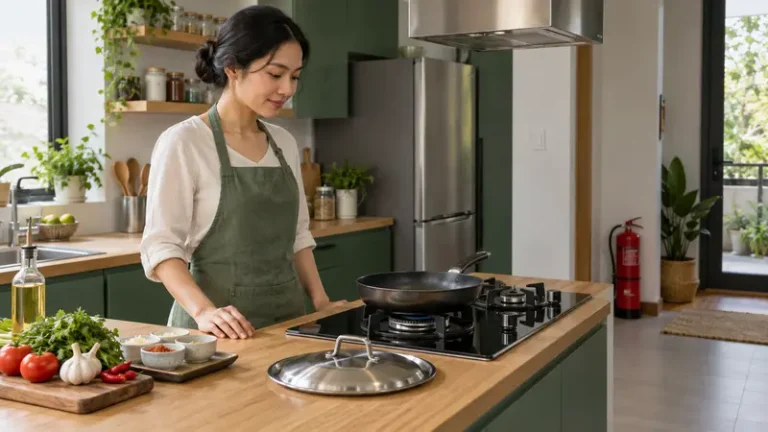
- Slide a suitable metal lid or baking sheet over the pan to limit the oxygen supply, but only if the item is already nearby and your escape route remains clear.
- Leave the lid in place. Do not lift it to check the fire and do not move the pan. Allow everything to cool completely before taking further action.
The U.S. Consumer Product Safety Commission recommends sliding a lid over the flames, turning off the heat and leaving the lid in place until the pan is cool. The U.S. Fire Administration also recommends keeping a pan lid or baking sheet close to the cooking area. These steps apply only when you can approach safely. If you are unsure, leave the area.
If the fire is large, spreading or producing heavy smoke
- Warn anyone nearby and get everyone out of the area.
- Close the door behind you if you can do so safely to slow the spread of fire and smoke.
- Call the Fire Prevention and Fighting Police and Rescue force on 114 from a safe location.
- Do not go back for belongings and do not continue fighting the fire if your escape route may be cut off.
Four reactions to avoid
| Do not | Why it is dangerous | Safer choice |
|---|---|---|
| Pour water into the pan | Water can vaporize suddenly and force burning oil outward. | Do not use water; assess whether you can turn off the heat, cover the pan or leave safely. |
| Carry the pan outside | Hot oil may spill or splash onto you, and the fire can spread along the route. | Keep the pan stable; do not block your escape route to save cookware. |
| Pour flour onto the fire | The CPSC specifically advises against using water or flour on a cooking fire. | Use a suitable lid when it is safe to do so; otherwise, leave the area. |
| Lift the lid too soon | Fresh air can allow flames to return while the oil is still hot. | Keep the lid in place until the pan has cooled completely. |

Prevent a grease fire before flames appear
- Stay in the kitchen while frying. If you need to leave, turn off the heat first.
- Respond to early warning signs. If oil begins to smoke or behaves unusually, turn off the heat when it is safe to do so.
- Keep a suitable lid close to the cooking area. Do not store it somewhere that requires you to pass through flames to reach it.
- Keep towels, paper, packaging and other flammable items away from the stove.
- Turn pan handles inward to reduce the risk of knocks, spills or children pulling them down.
You can also read Cookmate’s guidance on staying focused while cooking, common fire hazards around the kitchen and how to clear a safe zone before cooking. Those articles focus on prevention; this one explains why water makes a grease fire more dangerous and what to prioritize when an incident occurs.
Frequently asked questions
Should you use a fire extinguisher on a pan of burning oil?
Only consider it if the extinguisher is clearly rated for the type of fire, you have been trained to use it and you can keep an escape route behind you. Do not guess the extinguisher type from its color or try to learn how it works during an emergency. If you are uncertain, leave and call 114.
Does the principle change with a gas, electric or induction stove?
No. The main hazard is burning oil coming into contact with water. The type of stove affects how you turn off the heat, so follow the instructions for the specific appliance and act only when it is safe.
What if the oil is smoking but has not caught fire?
Do not wait for flames. Turn off the heat when you can do so safely, do not move the hot pan and allow the oil to cool. Do not add water or wet food to oil that is overheating.
Peace of mind starts with the right response
Cookmate’s promise of “Peace of mind for every Vietnamese kitchen” is built on suitable equipment, clear guidance and responsible everyday habits. Explore the Safety Education section for practical ways to build calmer responses to common kitchen risks.
Sources
- Vietnam Fire Prevention and Fighting Police and Rescue force — Fire safety measures for household gas use, published 28 July 2022; used to confirm the nationwide fire and rescue emergency number 114 and the household safety context.
- U.S. Fire Administration — Cooking Fire Safety, reviewed 4 May 2023; supporting guidance on staying in the kitchen, recognizing overheated oil and keeping a lid nearby.
- U.S. Consumer Product Safety Commission — Recipe for Safer Cooking; supporting guidance on covering the pan, turning off the heat, not moving the pan and not using water or flour.
- London Fire Brigade — What to do if a pan catches fire?; supporting guidance on the fireball risk from pouring water, turning off the heat when safe and prioritizing escape.
Note: This article provides educational and practical safety guidance. It does not replace instructions from the fire service, a household emergency plan or training in the use of fire-extinguishing equipment.