


Commercial Kitchen Safety vs. Lowest-Price Plans
A safety-first commercial kitchen plan is not defined by a high price. It is defined by how well the plan fits the cooking model, available space, energy sources, ventilation, staff and maintenance requirements. The purchase price is one figure to control; if the lowest price is the only decision criterion, important operating conditions may remain unclear.
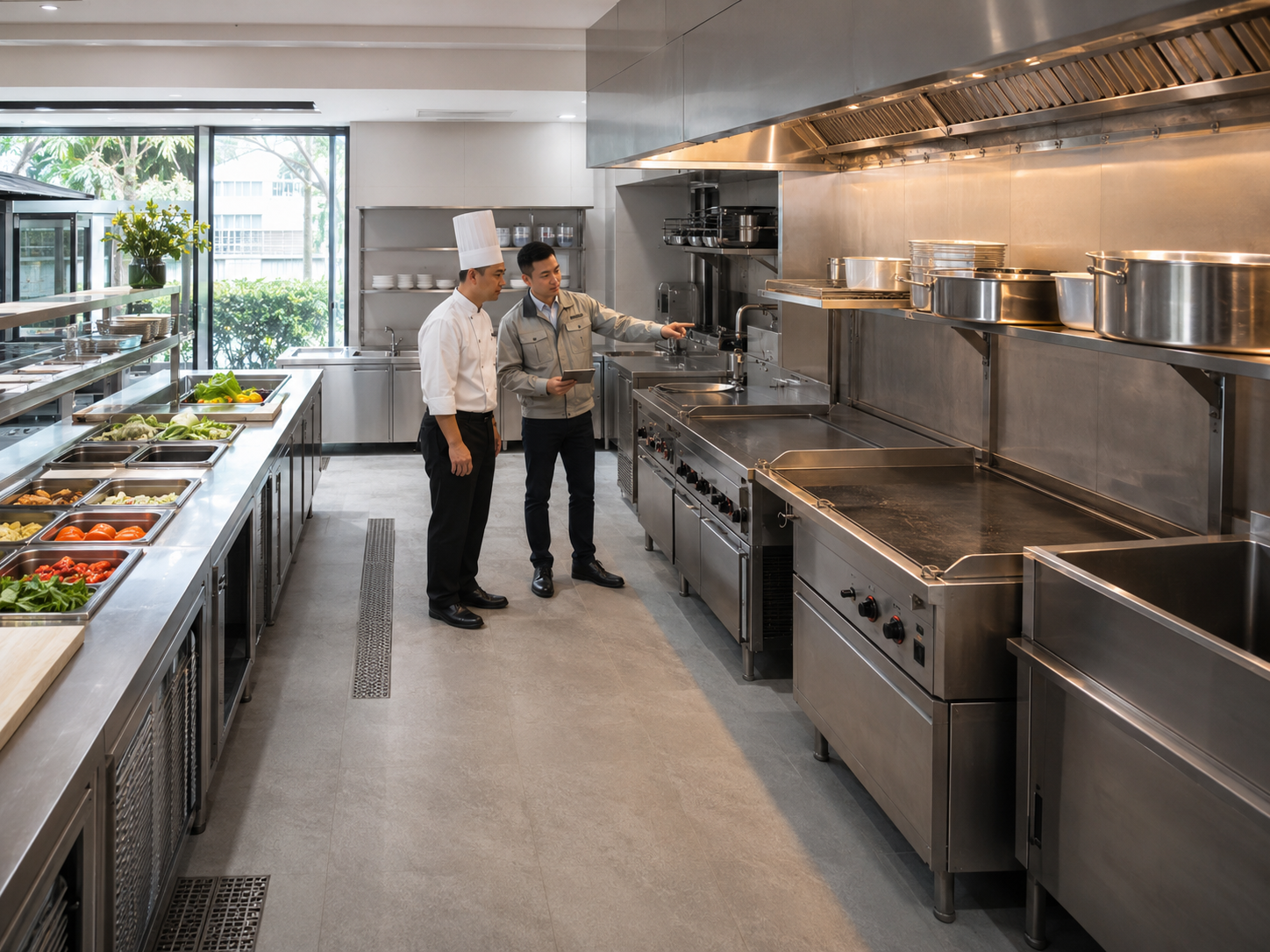
Key takeaway: “Low price” does not automatically mean “unsafe”, and “high price” does not automatically create a suitable kitchen. What needs to be compared is the scope of the solution, equipment evidence, installation conditions and responsibilities after handover.
The Difference Is Not in the Price Tag
In a restaurant project, two quotations may list the same stove, hood, stainless-steel tables and accessories, yet still solve two different problems. A plan focused only on purchase price often starts with the question, “Which item costs less?” A safety-first plan starts with, “What will this kitchen cook, how long will it operate, who will use it and what are the actual site conditions?”
The second set of questions reveals details that are easy to overlook: Is the equipment suitable for the expected frequency of use? Do staff movement and hot cookware cross paths? Can cleaning and maintenance points be reached? Are ventilation and exhaust systems compatible with the cooking line? Have staff received operating instructions and a procedure for handling unusual conditions?
| Criteria | Plan focused only on purchase price | Plan prioritizing safety and operations |
|---|---|---|
| Input data | Equipment list and total budget. | Menu, output, peak hours, fuel, floor plan and staff capability. |
| Layout | Priority is fitting all required equipment into the available area. | Reviews workflow, hot surfaces, walkways, cleaning areas and maintenance access. |
| Equipment | Compared mainly by price and headline specifications. | Checks the exact model, user instructions, relevant documentation, installation conditions and suitability for the menu. |
| Ventilation and energy sources | May be treated as a secondary item or addressed later. | Reviewed together with the cooking line, heat load, grease vapour and site conditions. |
| Handover | Considered complete when the equipment can run. | Includes instructions, assigned responsibilities, maintenance information and a response procedure for unusual conditions. |
| Cost | Focuses on the initial payment. | Compares the supply scope and work required throughout the equipment’s service life. |
Six Questions to Ask Before Approving a Kitchen Plan
1. What dishes will the equipment support, and at what operating pace?
Equipment suitable for occasional table-service preparation may not be suitable for a continuous cooking line. Equipment used from time to time should not be evaluated in the same way as equipment operating through peak hours. Confirm the menu, cookware, number of cooking stations, fuel supply and operating responsibilities before comparing models.
2. Do people, food and hot utensils cross paths?
OSHA identifies hazards in restaurant cooking areas that include hot surfaces, grease, electrical equipment, slippery floors and obstructed spaces. This is an international reference and does not replace Vietnamese regulations, but it illustrates why layout must be reviewed together with real tasks: pan handles should not extend into walkways, frequently used items should be within a practical reach and floors should be kept as clean and dry as operating conditions allow.
3. Have exhaust, ventilation and fire-safety conditions been reviewed with the cooking line?
NFPA 96 covers prevention and operating requirements related to ventilation and fire protection for commercial cooking operations. For projects in Vietnam, application must follow the applicable documentation, competent-authority requirements and advice from a qualified professional; an international dimension or configuration should not be applied mechanically to every kitchen.
4. Are gas, electrical supplies and emergency shut-off points easy to identify?
The Vietnam Fire Prevention, Firefighting and Rescue Police advises checking equipment, valves and hoses, while keeping gas-use areas ventilated. If a gas smell is detected, avoid creating sparks and follow the applicable safety procedure. In a commercial kitchen project, energy-source locations and the method for isolating equipment during an abnormal condition should be determined, documented and explained clearly to the person in charge.
5. Is there enough space for cleaning, inspection and parts replacement?
If equipment fits into a position but the points requiring cleaning or maintenance cannot be reached, post-handover operation becomes difficult to control. Specific technical clearances must follow the manufacturer’s instructions, design documents and site conditions; there is no single figure that should be applied to every model.
6. Who is responsible after handover?
Clarify who keeps the user instructions, inspection schedule, service records, equipment list and contact details for handling unusual conditions. This connects directly with Cookmate’s five-layer equipment safety framework: one isolated feature cannot replace documentation, installation, operation and maintenance.

When Can a Lower-Priced Plan Still Be Suitable?
A lower-priced plan can be appropriate when the difference comes from a right-sized configuration, a clearly defined scope or the removal of unnecessary items — not from ignoring essential requirements. Before approval, the owner should check at least the following:
- The model and intended use match what was agreed.
- Suitable installation, operating and maintenance instructions are available.
- The quotation clearly states what is included and excluded.
- Ventilation, electrical, gas and floor-plan conditions have been reviewed by a competent professional.
- Access for cleaning, inspection and equipment isolation has not been removed.
- There is a support contact and a method for recording issues after handover.
Conversely, a high-priced plan that lacks operating data, does not identify exact models, leaves installation conditions unclear or provides no post-handover responsibility is not automatically a safety-first plan.
Three Signs a Quotation Needs Further Clarification
- Only generic item names are listed: the quotation does not state the model, energy source, operating conditions or accompanying documents.
- The scope of work is unclear: it is not clear who is responsible for exhaust, electrical or gas supply, site checks, testing and staff instruction.
- There are no acceptance criteria: “the equipment operates” is not enough if layout, workflow, abnormal conditions and handover documents are not checked.
A 2 March 2026 fire-safety recommendation for production and business facilities from Vietnam’s Fire Prevention, Firefighting and Rescue Police emphasizes checking electrical systems and machinery, collecting combustible materials, arranging goods appropriately and keeping escape routes clear. In a restaurant kitchen, these principles should become a site-specific checklist based on the facility’s layout and records, rather than appearing only as a general statement in a quotation.
A Simple Approval Process with Clear Evidence
- Confirm operating data: menu, expected output, service periods, staffing, fuel and floor-space limits.
- Review risks by area: heat, grease, gas, electricity, water, walkways, cleaning and maintenance.
- Compare like with like: model, accessories, delivery, installation, testing, instruction and after-sales support.
- Verify documentation: use information for the exact model; do not extend a certification or feature from one product to another.
- Test and hand over: record the person in charge, conditions that require equipment shutdown and the support channel.
This is Cookmate’s suggested decision-support process, not a technical standard or a fire-safety approval plan. Each project must follow applicable regulations, manufacturer instructions and an assessment by an appropriately qualified professional.
If the operating kitchen has a gas smell, hot or damaged wiring, abnormal equipment behaviour, heavy grease build-up or blocked escape routes: prioritize stopping use of the affected area when it can be done safely, avoid creating sparks and contact the responsible technician or appropriate emergency service. Do not attempt to dismantle or repair gas or electrical systems without the required expertise.
Choose a Solution Based on Context, Not One Number
A dependable kitchen must balance budget with suitability, operating capability and long-term responsibility. Restaurant owners can review Cookmate’s guidance on optimizing commercial kitchen space and explore Cookmate equipment solutions before preparing an equipment list.
For projects that require coordinated design and brand identity at the point of sale, brand expression should be aligned with operating requirements from the beginning, so visual appeal does not obstruct access, ventilation or technical service points.
Cookmate — Peace of mind for every Vietnamese kitchen.
Start with the real operating model. Cookmate can support HORECA partners in reviewing equipment needs and the questions to clarify before a plan is approved; technical design, installation and fire-safety work must be carried out by qualified parties according to the applicable documentation.
References
- Vietnam Fire Prevention, Firefighting and Rescue Police — Fire-safety measures for household gas use, published 28 July 2022.
- Vietnam Fire Prevention, Firefighting and Rescue Police — Fire-safety recommendations for production and business facilities, published 2 March 2026.
- NFPA 96 — Standard for Ventilation Control and Fire Protection of Commercial Cooking Operations, supplementary international reference.
- OSHA — Restaurant Safety: Cooking, supplementary international reference on cooking-area hazards and practices.
Sources checked on 31 August 2026. This article is educational and intended to support better questions; it does not replace design documents, manufacturer instructions, technical advice or requirements from competent authorities.